
Airbnb: content design for Self-serve Enablement
The challenge
Ship help center chatbot solutions for high-stakes journeys while improving findability across the help center at scale.
In a 6-month contract, I wrote and shipped 3+ high-visibility Smart Solutions across critical guest/host moments and partnered with the UX Writing team to rewrite 400+ help center menu labels/headers to improve ML-search findability and translation-ready consistency.
Each project required deep research and empathy across three personas (guests, hosts, agents), close collaboration with Chatbot, AI, and Machine Learning PMs + engineering, and language natural enough to translate cleanly into 61 locales. Here’s how.
SERVICES Product writing & editing; UX research; content strategy; information architecture; conversation design (chatbot); localization-ready writing; experimentation support; cross-functional collaboration
PROJECT Deliver high-impact Smart Solutions in the help center chatbot for (1) identity verification, (2) refunds/cancellations, and (3) on-trip issue triage; improve help center navigation/findability through menu-label system updates.
STRATEGY
Write for speed and clarity: design findable headers, support text, and CTAs that help users self-serve without contacting agents.
Ground decisions in evidence: review support tickets and agent conversations, align to help center IA, and validate copy against common failure modes and edge cases.
Collaborate tightly with product and engineering: iterate within platform constraints, align with experimentation needs, and ensure solutions are measurable and maintainable.
Optimize for global readability: keep language natural and concrete so translation notes and string-by-string explanations are largely unnecessary.
RESULTS
Shipped measurable self-serve improvements: Wrote 3+ high-visibility Smart Solutions (identity verification, refunds/cancellations, on-trip triage) that reached statistical significance within ~8 weeks and were reported to drive multi-million-dollar cost savings through deflected contacts.
Improved help center findability at scale: Rewrote 400+ menu labels/headers using system guidelines to support federated ML search and consistent, translation-ready language across 61 locales.
ESTIMATED CONSERVATIVE–AGGRESSIVE FINANCIAL IMPACT Because I can’t publish internal cost-per-contact or exact deflection rates, I estimate impact using common support economics: $3–$12 per deflected contact multiplied by the annual deflection implied by “millions saved.”
If Smart Solutions deflected roughly 250k–1.5M contacts/year, annualized savings range is approximately $0.75M–$18M.
This range is intentionally wide to reflect uncertainty; the internal finding of “millions saved” sits within this band depending on assumed cost-per-contact.
Visit the site →
The solution
Human-Centered Content Design for self-serve enablement
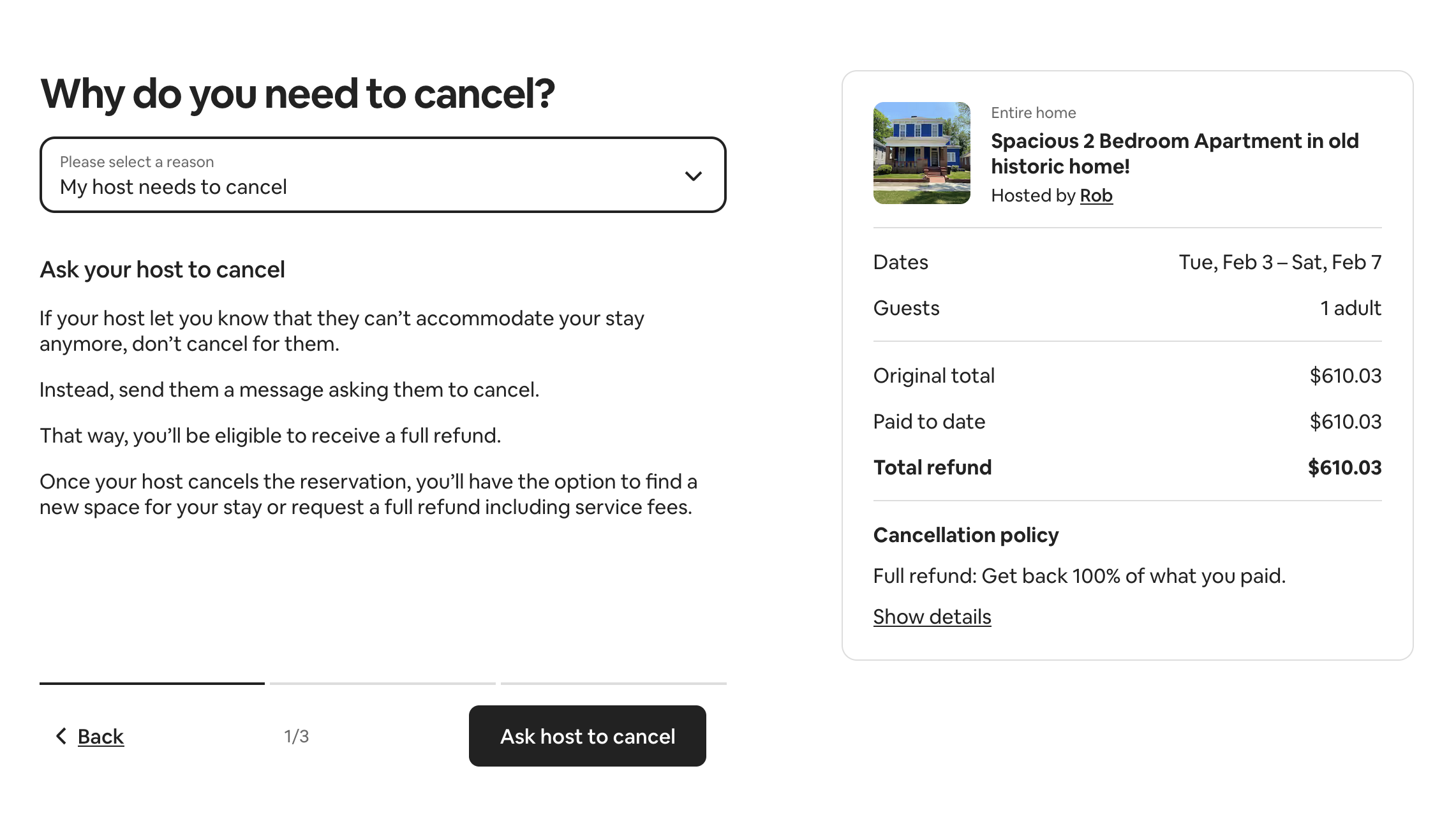
refunds and cancellations
Enabled self-serve refunds and cancellations that helps guests and hosts choose the right option quickly and confidently, without an agent.
Introduced a dropdown selection pattern to cover the full set of refund/cancellation reasons without overwhelming users
Ensured the experience supported all personas (guest, host, agent) with the right next step at the right moment
Wrote clear, non-judgmental option labels and support text that reduced cognitive load and set expectations
Partnered with Chatbot/AI/ML PMs, engineering, and design to ensure the flow captured the right signals for routing, outcomes, and reporting
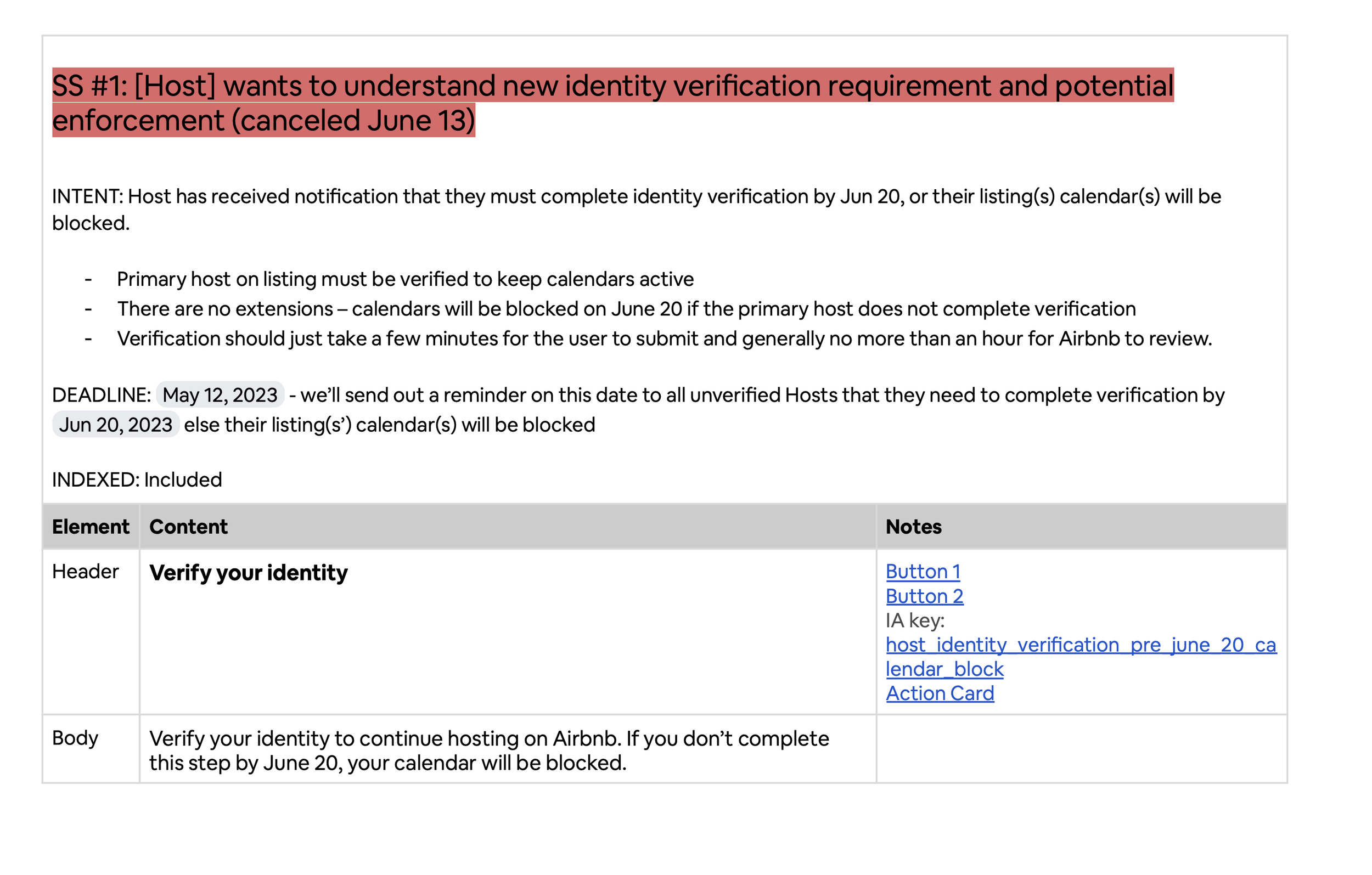
Identity verification
Supported identity verification completion with ethical Smart Solution copy that clearly explained why verification mattered, set expectations, and guided hosts and guests through the flow—without fear tactics or coercive language.
Audited support tickets and agent conversations to pinpoint persona gaps, emotional friction, and the moments users abandoned verification
Partnered with Chatbot, AI, and ML PMs + engineering to align on constraints, required steps, and what the chatbot could (and couldn’t) resolve in-flow
Wrote microcopy (header, support text, 2–3 CTAs) that balanced clarity with empathy, empowering users across personas to take the next step confidently
Structured CTAs to match user intent (start/continue verification, troubleshoot common failures, get help when blocked) while keeping language localization-ready for 61 locales
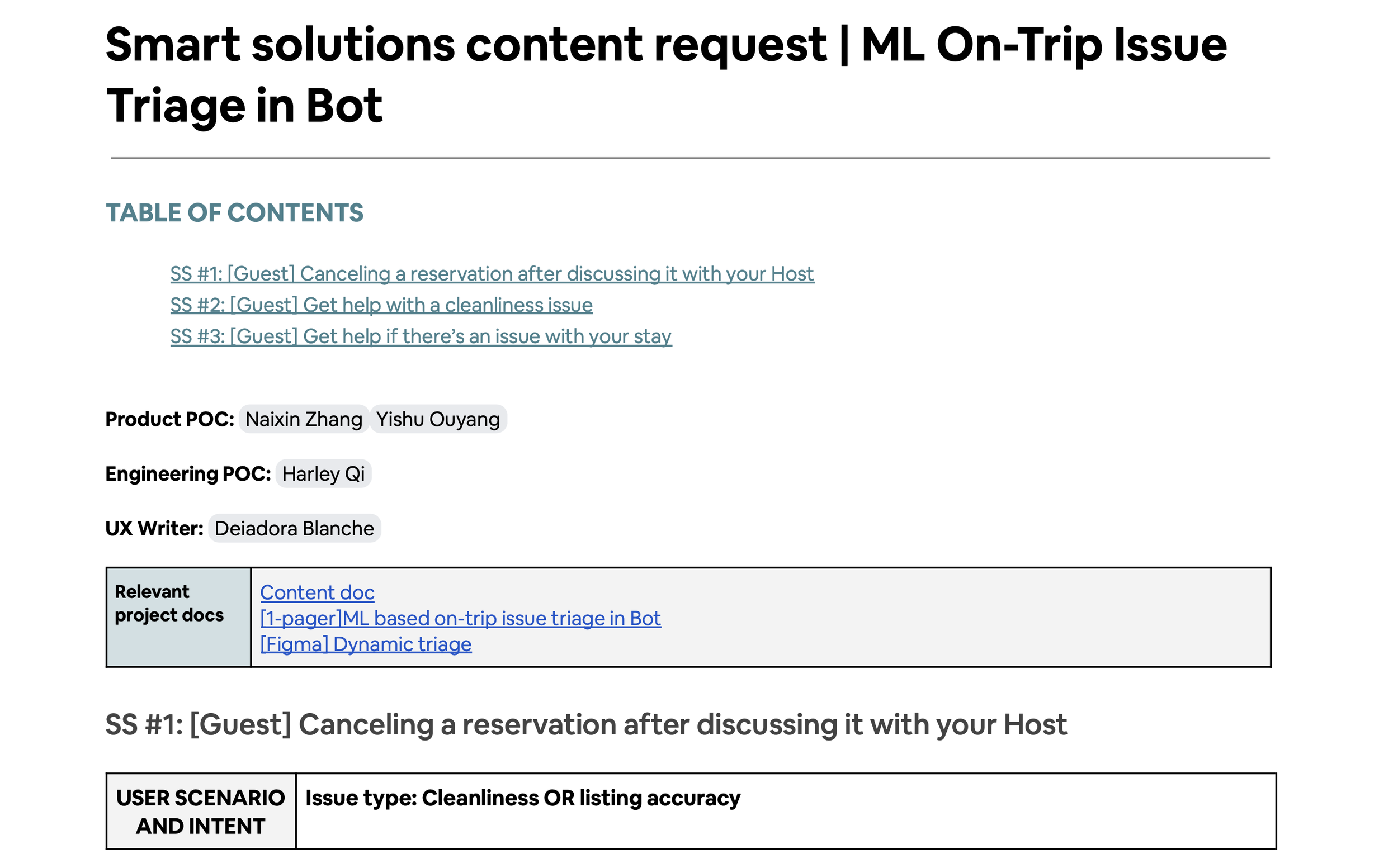
On-trip issue triage
Initiated on-trip issue triage with Smart Solutions that helped guests act fast in high-stress moments—guiding them to the right next step (contact host vs. self-serve cancellation) without waiting for an agent, while keeping the experience human-centric and cost-efficient at Airbnb scale.
Audited UX research, data science findings, and recent support tickets to identify the most common on-trip issue patterns
Synthesized insights into 3 primary on-trip scenarios and wrote Smart Solutions tailored to each
Clarified urgency and decisioning with guidance that routed users to host contact or self-serve cancellation depending on context
Reduced escalations by making the next best action obvious—supporting faster resolution and meaningful support cost deflection
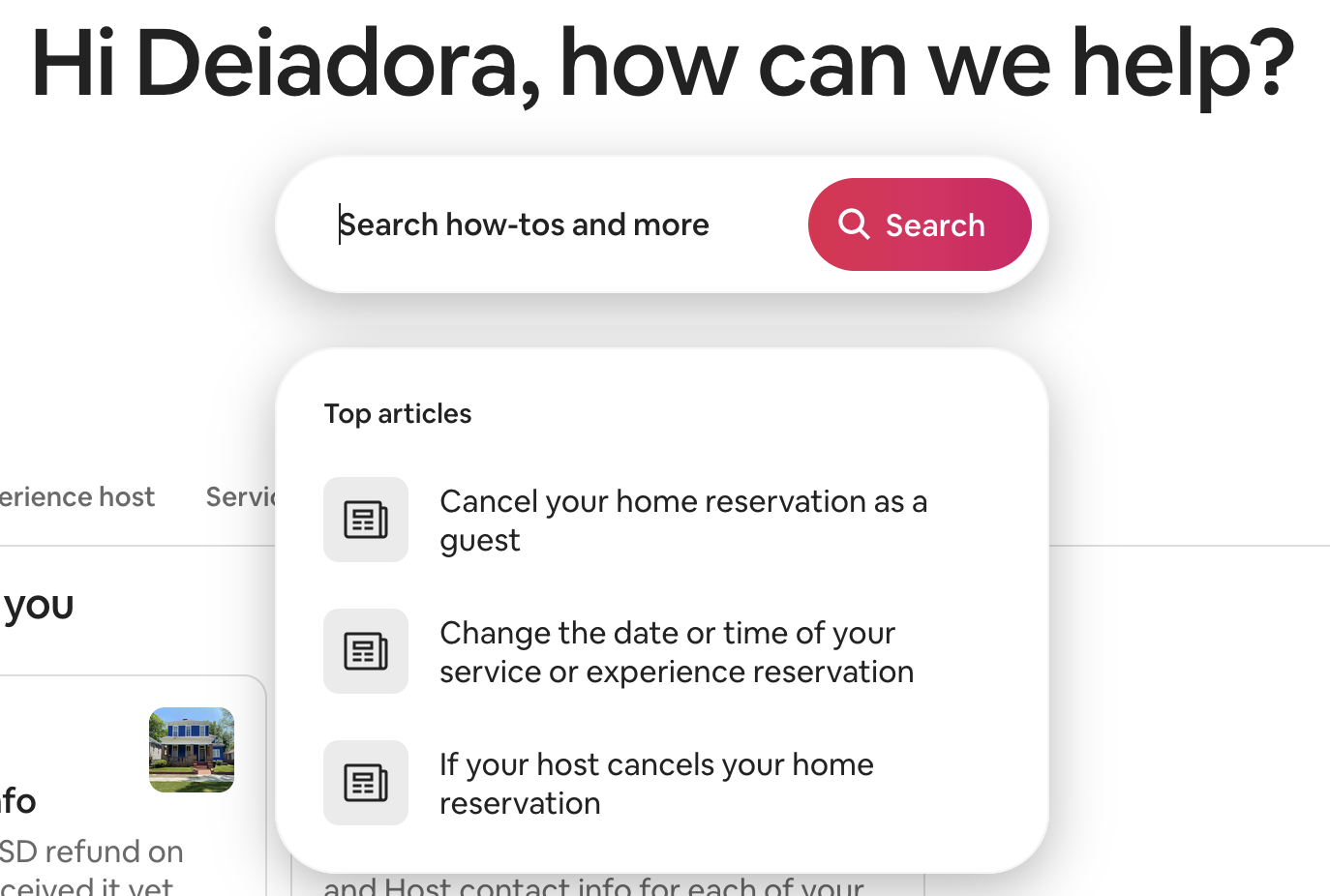
menu headers for findability
Improved help center findability by rewriting 400+ menu headers/labels using updated system guidance—collaborating with the internal UX Writing team to close gaps in the standards before the work shipped, then validating patterns with design in Figma for a smooth engineering handoff.
Audited existing menu items and compared “live” usage against the newly published header standards to identify gaps, inconsistencies, and missing rules
Proposed practical updates to the guidance and aligned quickly with the project lead (low-ego, high-collaboration) before the rewrite began
Applied agreed patterns to rewrite 400+ headers efficiently, escalating only a small set of ambiguous cases via async comments
Partnered with design to sanity-check length and layout in Figma across representative scenarios prior to eng handoff
Delivered more natural, keyword-rich, sentence-like headers that improved metadata consistency and made a large help center corpus easier to navigate and search